


Until now, Cage Calculus’ rankings have not featured a pound-for-pound ranking. We have noted, “The CC Rating is a metric of dominance and performance as opposed to talent relative to size. So, [cross-divisional rankings] will simply be called ‘Overall Male’ and ‘Overall Female’ rankings.”
With the CCz Score, that ends today. The CCz Score is a score that shows how much better a given fighter is than the average fighter in their respective weight class. For example, if a lightweight fighter has a CCz Score of 1.000, that indicates they are one standard deviation better than the average lightweight in the CC Ratings.
The CCz Score is an important addition, as the average rating differs greatly by weight class. For example, the average men’s flyweight is rated 1618.3, whereas the average men’s light heavyweight is rated 1675.4. Divisions also differ in their standard deviations. Some divisions are very top heavy, whereas others are more closely packed together with even competition. The CCz score takes this into account to create an even standard metric of which fighters tower above their peers most dominantly.
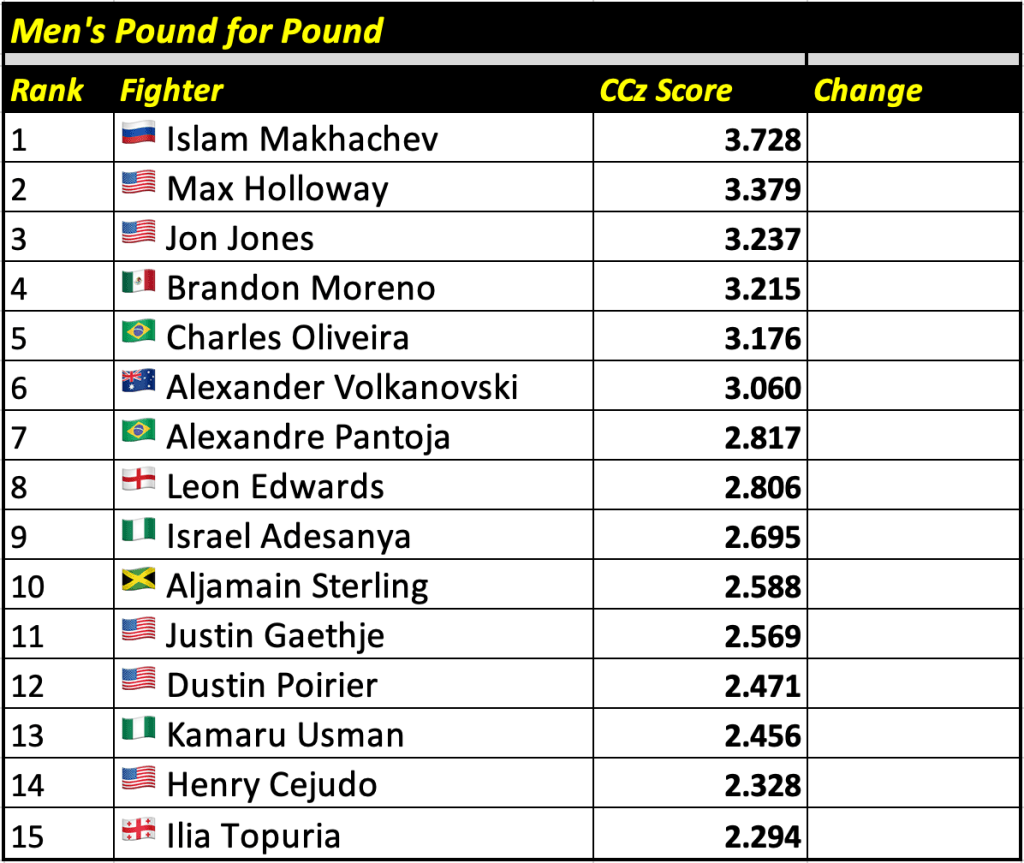
The CCz Score is calculated by taking a fighter’s rating, subtracting the average rating for their division, and then dividing it by the standard deviation (like a “z score” in statistics). For example, newly-minted featherweight champion Ilia Topuria has a new CC Rating of 1871.8 after his victory at UFC 298. The average featherweight has a CC Rating of 1647.9. The standard deviation for a featherweight is 97.6 rating points. So, for Ilia Topuria…
- 1871.8 – 1647.9 = 223.9
- 223.9 / 97.6 = 2.294 CCz
The new Cage Calculus Pound for Pound Rankings, based on a fighter’s CCz Score, will now be published every week along with our regular rankings. Don’t worry, the CCz Score is not a replacement for the traditional CC Ratings, just an additional metric to judge a fighter’s dominance. Below, here is a view of where things stand now. Without further ado, Cage Calculus’ first ever Pound for Pound Rankings:

 Cage Calculus