

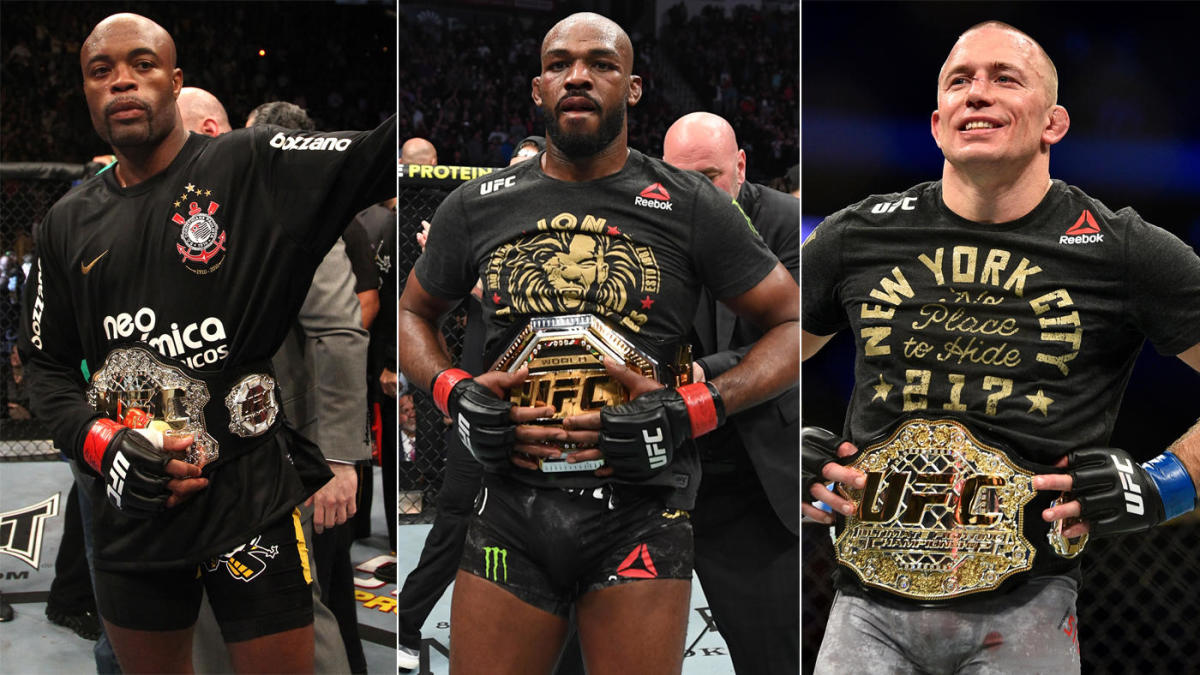
If you were to ask any fan of the Ultimate Fighting Championship (UFC) who the “greatest of all-time” (GOAT) is in the sport, you’d likely get a flurry of different answers. Among the most popular might be former middleweight champion, Anderson Silva (pictured above left), former light heavyweight champion (and potential future heavyweight title contender) Jon Jones (pictured above center), or former two division weight champion Georges St-Pierre (pictured above right). Others, like UFC commentator Joe Rogan, might give an answer like former flyweight champion Demetrious Johnson. The debate has raged for years, and will continue to do so as the sport evolves, new champions cement their legacies, and older legacies get put into perspective.
The mission of Cage Calculus is not to settle these debates, but to fuel them! Using the Cage Calculus forecast algorithm, we can break down the fight history of every one of the 2,227 fighters who have stepped foot in the UFC octagon in their career. Who stands out above the rest? Who compiled the most impressive legacy? The Cage Calculus data can’t give one definitive answer, but it can give an in-depth, data-driven analysis of the GOAT debate based on a number of different criteria. The rest is up to you.
After compiling the data, Cage Calculus believes there are ten men who can reasonably stake a claim to be the greatest men’s fighter in the history of the UFC:
- Jose Aldo
- Daniel Cormier
- Matt Hughes
- Demetrious Johnson
- Jon Jones
- Stipe Miocic
- Khabib Nurmagomedov
- Anderson Silva
- Georges St-Pierre
- Kamaru Usman
Over the next couple of weeks or so, Cage Calculus will profile the careers of each of these men and present both the case for and against them being considered the GOAT of men’s UFC. These profiles will focus on five different criteria to analyze the fighters career, along with a series of other observations specific to that fighter, which may lie outside of the data.
Overall CC Rating
The CC Rating is the bread and butter of Cage Calculus. It combines a number of the other factors considered and combines them into one metric. CC Rating is a product of who you’ve beaten, how often you win, how you perform in title fights, and your ability to finish fights.
As comprehensive as this metric is, we can’t merely look at who attained the highest ever CC Rating and call the debate settled. A fighter who wins twelve title fights by decision may rise above a fighter who won six, but all by knockout. Different people evaluate different things when looking for their GOAT. The CC Rating can wrap all of those data points above into one concise number, but can’t tell you how to weight everything else.
As you can see from the chart below, it is not at all an easy task to identify one of those career lines immediately as “the best” of them all.
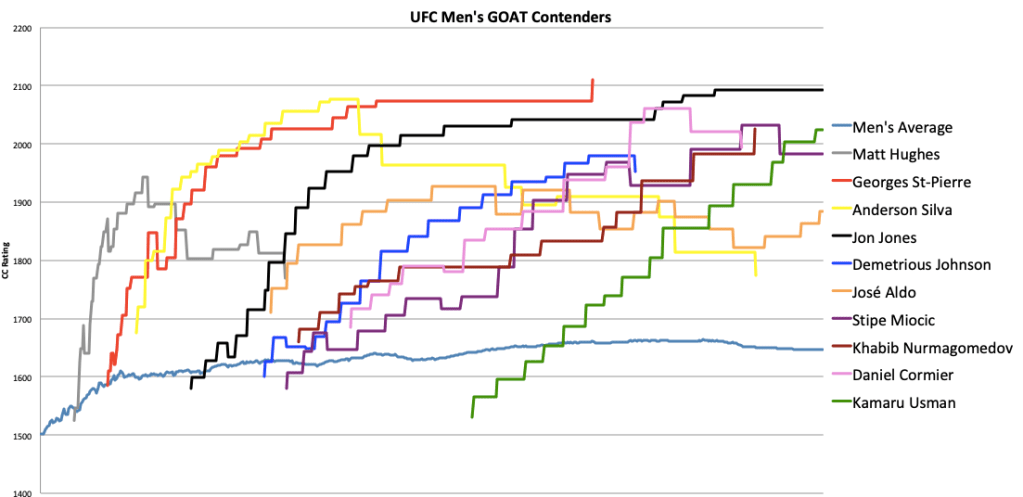
Also, because of the addition of new fighters, new weight divisions, and the elimination of underperforming fighters over time, the average CC Rating for a UFC fighter has drastically inflated over time. You can see the men’s average line on the chart above gain almost 150 CC points from UFC 1 to the present day.
Strength of Schedule/Victory
Simply put, we will break down the quality of opponents each of our ten GOAT contenders faced in their UFC careers. How did they compare to the fighters of the day, and how did their results differ based on the quality of opponent? It’s one thing to dominate a UFC weight class. It is another thing entirely to do it against the highest level of competition possible.
Finishing Ability
Defeating a high caliber opponent is impressive. What’s even more impressive is removing said opponent from consciousness or even forcing them to give up their will to continue. Finish wins add points to a fighter’s CC Rating and bolster their legacies in the minds of UFC fans across the world.
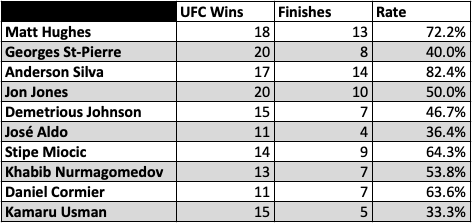
We’ll go beyond the surface level numbers above to look at some of the particularly impressive, career-defining finishes for each of these men. We’ll also go deeper into the caliber of opponents they were able to finish. We will also look to see how varied their finishes were. Some fighters excel as submission artists, some are KO threats on their feet, whereas others excel in both areas.
Title Runs
Naturally, each of these GOAT contenders were, at some point in their careers, a champion. Usman is the only one of the bunch who is currently the champion of their division. For this category, we’ll look at the dominance of each fighter during their title reign and how they performed when they lights were the brightest and the stakes were the highest.
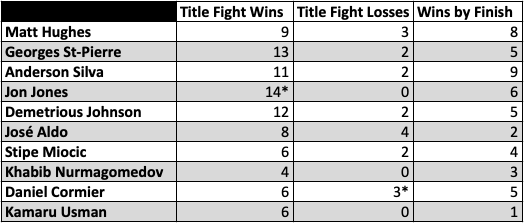
In addition to their record in title fights, we will look at the finish rate within their title reigns, as well as the strength of the opponents they fought in that reign. We will also consider whether or not they were able to attain title success in multiple weight classes (of these ten, only St-Pierre and Cormier attained belts in multiple divisions).
Contextual Dominance
For this last category, we’ll look at how fighters fared compared to the average fighter during their careers, how far above the rest of the pack they were at any given time, and how strong the rest of their weight class was. Dominating a relatively light division might not hold as much weight as a run of dominance in one stacked from top to bottom. It’s also important for the GOAT to at one point at least have been the greatest of their era.
Miscellaneous Observations
The UFC doesn’t happen in a vaccuum, nor can it be summarized by mere data points (try, though we may). We’ll add subjective context over all these points to fill in the gaps the data might missed. What else was going on outside the octagon? What kind of skills were displayed in the cage? What impact did the fighter make on the sport?
Honorable Mentions
Here are some of the fighters who just missed the cut to be considered for this list of the potential greatest of all-time.
Conor McGregor
Yes, you were waiting for this one, I’m sure. While McGregor was the first simultaneous double champ in UFC history, a lot of his perceived greatness is due to his reputation. He never once defended his undisputed featherweight title, nor did he ever defend his undisputed lightweight title. In fact, McGregor has only ever won one fight at 155 pounds, the weight class he currently occupies. His left hand may be the deadliest in the sport’s history and there may be no fighter who ever eclipses his star power, McGregor cannot warrant mention in the GOAT conversation now.
Henry Cejudo
Cejudo dethroned Demtrious Johnson as the flyweigh king and ended his run in the UFC. Cejudo would then go on to also claim the bantamweight title as well, becoming a double champ himself. However, Cejudo only defended each belt once before going into an early retirement, having compiled only ten wins in the UFC. He has teased that he will come out of retirement to fight for the featherweight title against Alexander Volkanovski, trying to become the first man to win titles in three weight classes. Were he to do that, he would instantly warrant his own GOAT profile. Until then, he’s on the outside looking in.
Max Holloway
Holloway is the current #1 contender in the UFC featherweight division. He ended Jose Aldo’s run of dominance and put together a nice run of five title wins himself. He even earned a chance to compete for lightweight gold, falling short in an interim title bout with Dustin Poirier. Holloway’s two KOs of Aldo and subsequent title run were impressive, but he’s since been dealt two defeats by the current champ Volkanovski (though one is debatable). He is still young and can enter the picture by getting back on top, but hasn’t done enough yet.
Chuck Liddell
The “Iceman” Liddell was perhaps the UFC’s first big star. He strung together five title wins in the light heavyweight division. However, once that title reign came to an end, so did Liddell’s success. He would lose five of his last six fights in the UFC, four coming by brutal knockout. His title reign, as important as it may have been for the UFC, was not long enough to worm his way into the GOAT discussion.
Randy Couture
Couture compiled a whopping 15 title fights in his UFC career, winning nine of them. He was the first UFC fighter to ever win belts in two divisions, doing so in the light heavyweight and heavyweight divisions. Despite his immense championship pedigree and trailblazer status, Couture never strung together more than four wins in a row in his entire career. His defining feature was longevity, not dominance. A legend for sure, but without a big win streak, it’s hard to say he’s the GOAT.
BJ Penn
One wonders what might have been in Penn’s UFC career absent his contract dispute that saw him go to K-1 kickboxing for two years right after he won his first UFC title. Penn never won back his welterweight title, but did go on a good run as lightweight champion, becoming another double champ. However, his run stopped at four, as he was defeated by Frankie Edgar. Penn then sadly ended his career on a seven fight losing streak. Penn played third fiddle to St-Pierre and Hughes in the welterweight division and his run at lightweight was stymied by a fighter who went on a similar run. He just misses GOAT consideration.
With that, the stage is set to heap coal onto the fire that is the UFC men’s GOAT debate. As mentioned earlier, detailed profiles of each of these ten men will roll in in the coming days, outlining their unique case to be considered the greatest of all-time.
 Cage Calculus